When importing or developing liquid packaging for cosmetics, personal care, or household cleaning products, selecting the right dispensing system is critical. Among them, the spray bottle is undoubtedly one of the most widely used yet mechanically sophisticated components.
But have you ever wondered about the exact physics under the hood? Understanding how a spray bottle works can help brands evaluate component quality, prevent leakage issues, and choose the ideal packaging specifications for different formulations.
In this comprehensive technical guide, we will break down the internal mechanism of a standard liquid spray bottle and analyze how its key components interact to deliver a perfect mist.
The Core Components of a Spray Bottle Mechanism
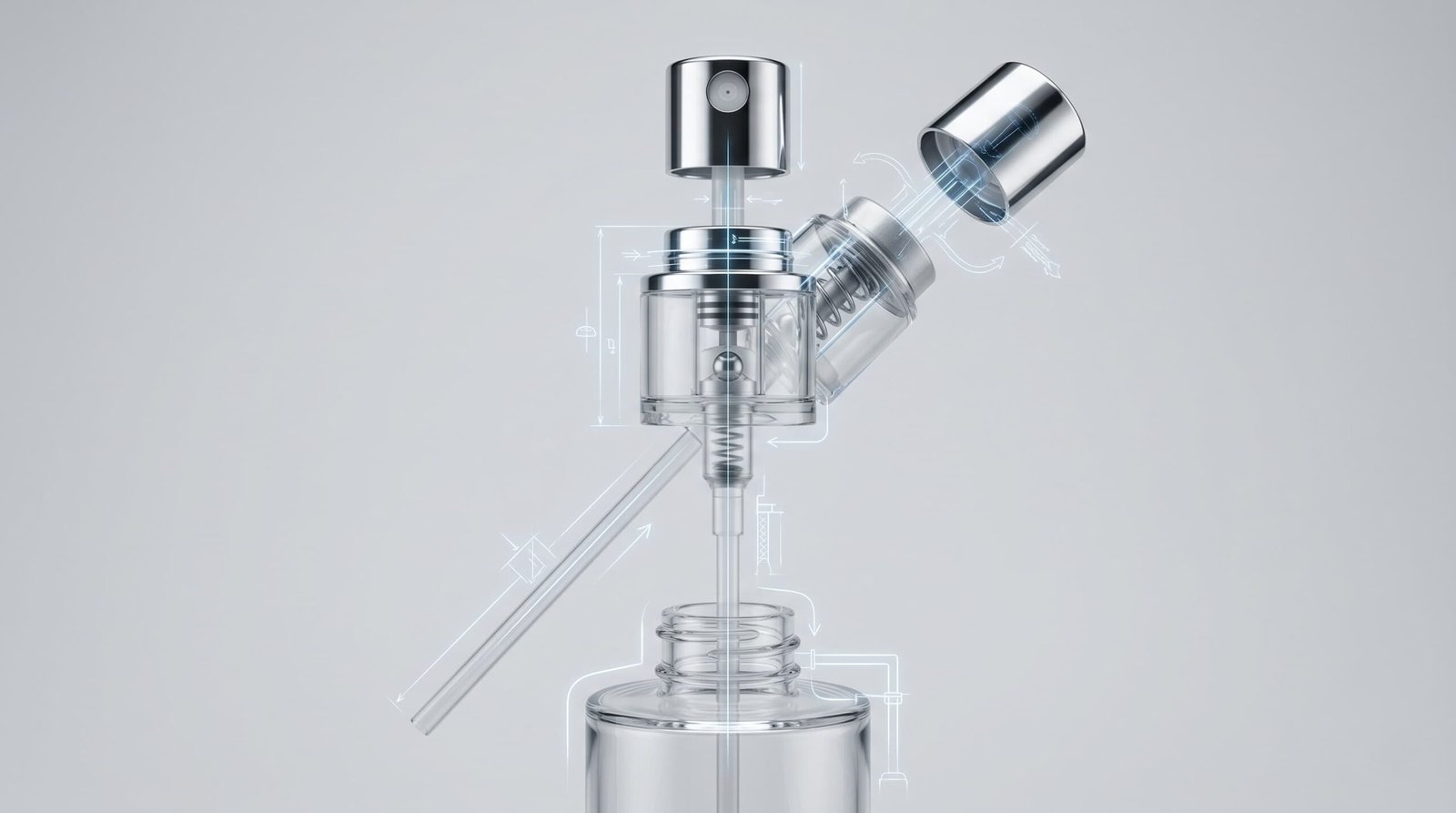
To understand the mechanical process, we must first identify the primary structural elements inside a standard fine mist sprayer or lotion pump assembly:
- Actuator (The Spray Head): The top part that the user depresses. It contains the microscopic orifice (nozzle) designed to break the liquid stream into a fine mist.
- Dip Tube: The narrow plastic tube that extends from the pump engine to the very bottom of the bottle container, acting as the pathway for the liquid.
- Pump Housing (The Cylinder): The main chamber that encloses the piston, stem, and spring assembly. It serves as the high-pressure engine of the sprayer.
- Piston and Spring: The mechanical heart that creates the necessary vacuum pressure. The spring provides the instant rebound force upon release.
- One-Way Ball Valves: Usually located at the base of the pump housing and inside the stem, these small spheres regulate the direction of fluid movement.
Step-by-Step: How a Spray Bottle Works
The entire dispensing cycle operates on a basic principle of fluid dynamics known as Boyle’s Law and Pascal’s Principle, utilizing pressure differentials to move liquid upward against gravity.
1. The Downward Stroke (Priming and Pressurization)
When a user presses down on the actuator, it pushes the piston into the pump housing. This action compresses the internal spring and drastically reduces the volume inside the chamber.
Because the volume decreases, the air or fluid pressure inside the pump housing spikes immediately. This sudden high pressure forces the lower one-way ball valve to shut firmly against its seat, preventing any fluid from being pushed back down into the dip tube. Simultaneously, the pressure forces the upper valve open, allowing the trapped compressed air or residual liquid to escape upward through the stem and out of the actuator orifice.
2. The Upward Stroke (Vacuum Generation and Suction)
When the user releases the actuator, the compressed spring instantly rebounds, pulling the piston back up to its original position. This upward movement expands the empty volume inside the pump housing.
According to fluid physics, expanding the volume within a sealed chamber creates a sudden drop in air pressure, forming a localized hydraulic vacuum.
3. The Siphoning Effect
Because the air pressure inside the pump housing is now significantly lower than the atmospheric pressure pushing down on the liquid inside the bottle container, a suction force is created. This pressure differential forces the lower one-way ball valve to pop open. Liquid is then drawn up from the bottom of the bottle, through the dip tube, and straight into the pump housing chamber, refilling it completely for the next stroke.
4. Atomization at the Actuator
Once the pump housing is fully primed with liquid, the next downward stroke forces the liquid at high velocity through a tiny, precisely engineered channel inside the actuator. As the high-pressure liquid stream hits the microscopic exit orifice, it undergoes atomization—breaking apart into thousands of uniform micro-droplets, creating a consistent fine mist or targeted spray pattern.
Versatile Applications Across Major Industries
The普适性 mechanics of the standard spray bottle make it highly adaptable. By adjusting the internal nozzle diameter, dosage output (e.g., 0.2cc to 4.0cc), and spring tension, factories can tailor the performance for various liquid viscosities.
Luxury Skincare & Cosmetics
In the clean beauty market, fine mist sprayers are vital for low-viscosity, high-value formulations. Products such as soothing facial toners, hydrating mists, makeup setting sprays, and liquid sunscreens require precise, ultra-fine atomization to ensure even distribution on the skin without leaving heavy droplets.
Personal Care & Haircare
For thicker formulations or larger volume distribution, heavy-duty sprayers are utilized. These are commonly found in professional salon hair styling sprays, detangling serums, leave-in conditioners, and body washes.
Household Hygiene & Cleaning
In industrial and family care sectors, spray mechanisms must withstand aggressive formulas. Standard spray bottles are optimized to dispense eco-friendly liquid soaps, surface disinfectants, hand sanitizing gels, and antibacterial body washes smoothly and reliably without component degradation.
Conclusion
Every time you press a spray bottle, a highly coordinated sequence of sealing, vacuum suction, and fluid atomization occurs within a fraction of a second. Checking the integrity of the actuator, the precise fitment of the pump housing, and the flexibility of the dip tube are the structural keys to ensuring a premium, leak-free consumer experience.