Plastic Compatibility: Sourcing Deodorant Stick Containers
Skip to content
Compatibility Testing: Choosing the Right Plastic Material for Oil-Based vs. Water-Based Deodorant Formulas
In the beauty and personal care industry, launching a successful product line requires perfect harmony between the formulation and its packaging. For brands developing deodorant sticks, one critical hurdle often stands between a stellar product launch and a costly recall: compatibility testing.
Selecting the wrong plastic material for your deodorant stick container can lead to catastrophic product failures—ranging from container warping and leakage to chemical leaching and perfume degradation. To make an informed sourcing decision, brands must understand how different plastic materials interact with oil-based (anhydrous) versus water-based (hydrogel or alcohol-water) formulas.
Here is an essential guide to navigating cosmetic packaging compatibility testing for your next deodorant project.
1. Understanding the Formulas: Oil-Based vs. Water-Based
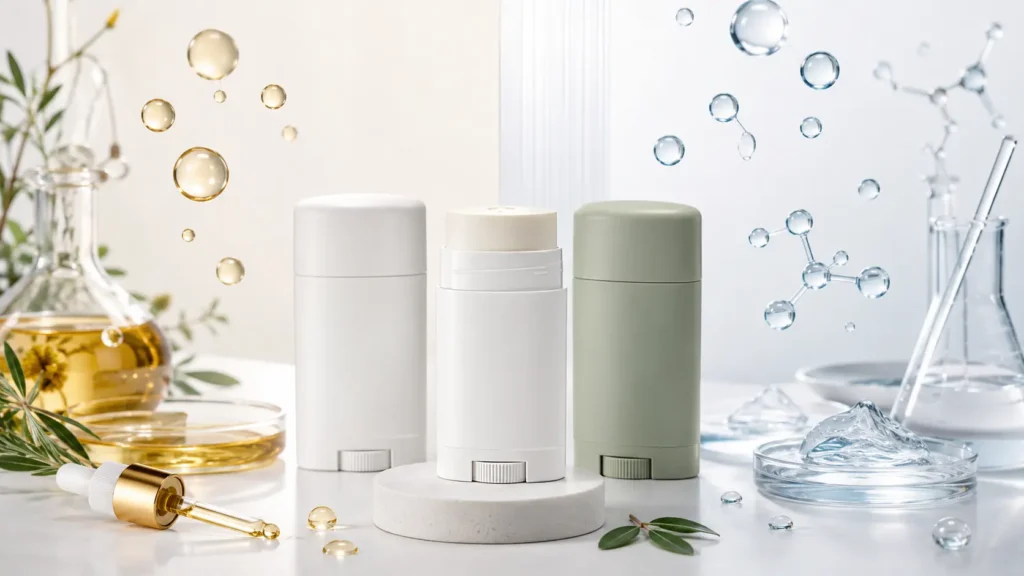
Before evaluating plastic materials, we must analyze the chemical nature of the deodorant stick mass inside the container.
Oil-Based / Anhydrous Formulas
Key Ingredients: Coconut oil, shea butter, ozokerite/beeswax, silicones (cyclopentasiloxane), and high concentrations of essential oils or synthetic fragrances.
The Sourcing Challenge: Lipids and volatile silicone oils are highly prone to migrating through certain low-density plastics. Essential oils (especially citrus derivatives) act as natural solvents that can stress-crack or soften weak polymers.
Key Ingredients: Water, propylene glycol or propanediol (as humectants and solvents), sodium stearate (the gelling agent), and active antiperspirant salts (Aluminum Zirconium).
The Sourcing Challenge: Water-based sticks are highly vulnerable to moisture loss and evaporation, which causes the stick to shrink and harden. Additionally, glycol-heavy formulas require excellent chemical resistance to prevent the plastic from becoming brittle.
2. Plastic Material Analysis for Deodorant Packaging
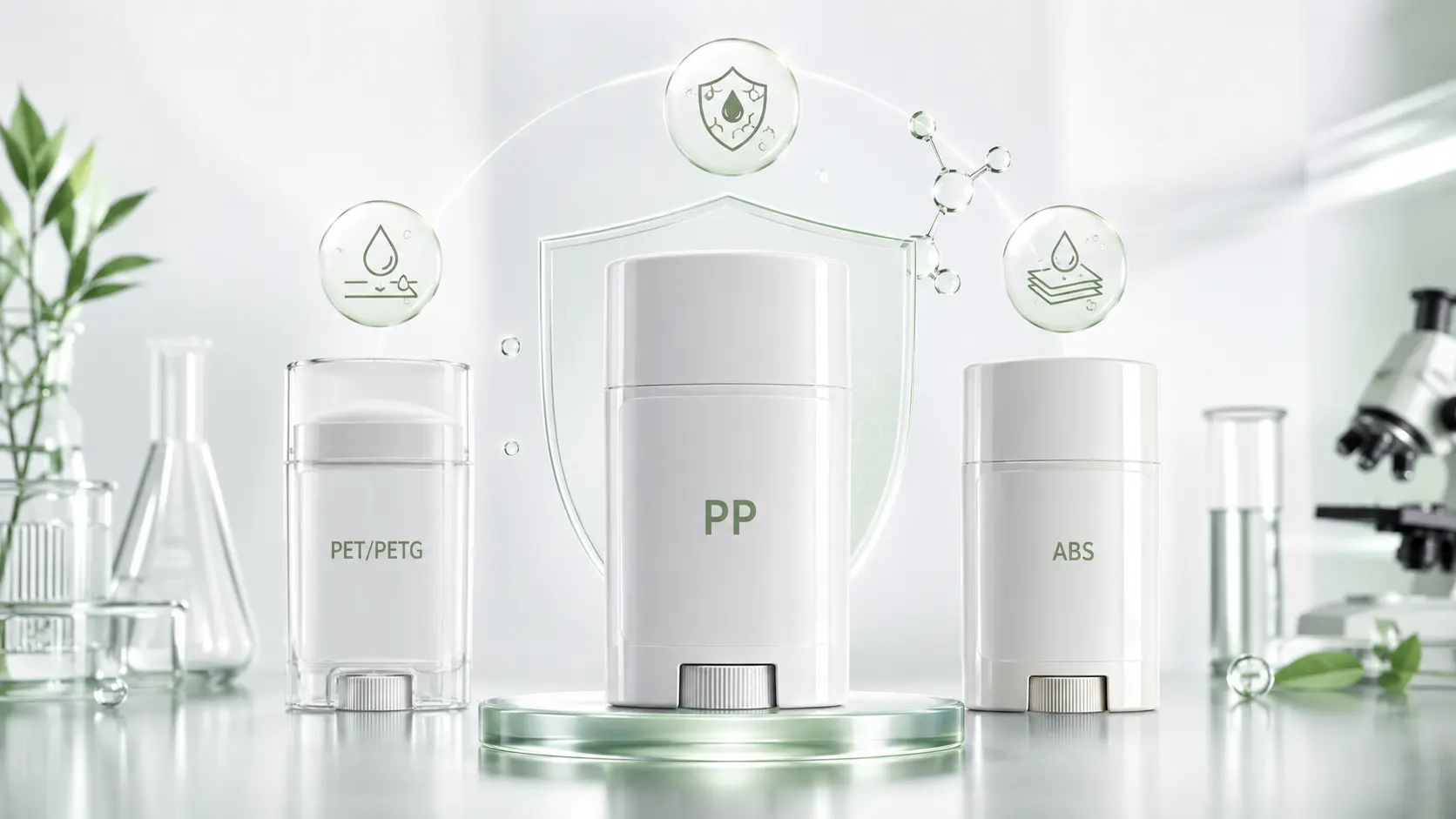
Not all plastics are created equal. When sourcing mono-material or PCR (Post-Consumer Recycled) packaging, you will primarily encounter three polymers: PP, PET, and ABS.
Plastic Polymer
Chemical Resistance
Barrier Properties
Best Suited For…
PP (Polypropylene)
Excellent (Resists both oils and glycols)
High moisture barrier / Moderate gas barrier
Ideal for both water-based & oil-based formulas. Excellent for mono-material designs.
PET / PETG
Good (Excellent gas and oil resistance)
High gas barrier / Moderate moisture barrier
High-clarity, premium packaging. Best for oil-based formulas; requires tight seals for water-based formulas.
ABS
Moderate (Can be attacked by certain essential oils)
Low moisture barrier
Outer shells or decorative caps. Avoid direct contact with hot-pour formulas.
Why PP is the Industry Standard for Deodorants
Polypropylene (PP) is highly favored for deodorant stick containers, particularly for hot-pour manufacturing processes. Deodorants are typically filled at temperatures between 55°C and 70°C. PP possesses a high melting point and exceptional thermal stability, ensuring the container does not warp during top-fill or bottom-fill production lines.
Furthermore, PP exhibits an extraordinarily low moisture vapor transmission rate (MVTR), which is vital for preventing water-based formulations from drying out over their shelf life.
3. What is Packaging Compatibility Testing?
Compatibility testing is a rigorous, mandatory scientific process where the final formulation is stored inside the target packaging under accelerated aging conditions. It determines whether the packaging and formulation can coexist for the duration of the product’s expected shelf life (typically 2 to 3 years).
A standard compatibility testing protocol evaluates three primary risk factors:
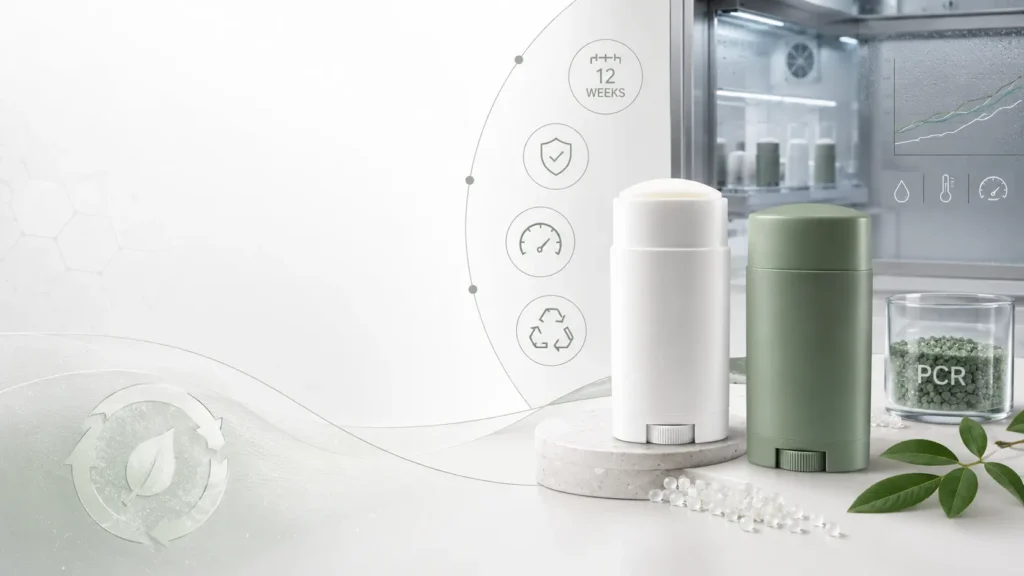
Weight Loss & Leakage Testing: Containers are weighed weekly at 40°C and 45°C to monitor evaporation rates. A total weight loss greater than 1% to 2% over 12 weeks generally indicates a barrier failure.
Stress Cracking (ESC) Analysis: Certain chemical compounds inside oil-based formulas reduce the tensile strength of plastics, causing the container base or mechanical elevator to crack under stress.
Organoleptic & Color Testing: Evaluates whether the plastic alters the product’s scent profile or causes the mass to turn yellow/brown due to chemical reactions with the polymer’s trace additives.
4. Sourcing Roadmap for 2026 Beauty Brands
If your brand is moving toward sustainable, refillable, or PCR deodorant stick systems, keep these strategic sourcing rules in mind:
Prioritize All-PP Mono-Material Systems: For seamless recycling and universal formulation compatibility, opt for 100% PP structures (including the internal spindle, screw, and cap). Mixing ABS caps with PP bodies complicates the recycling stream and increases chemical incompatibility risks.To understand how mono-materials solve the sorting challenges in municipal facilities, read our deep dive: Are Deodorant Stick Containers Recyclable? The Truth About Sustainable Stick Packaging.
Account for PCR Inconsistencies: If using Post-Consumer Recycled (PCR) PP, remember that recycled resins contain trace impurities from previous lifecycles. Run a full 12-week compatibility test even if you have previously passed testing with virgin PP.
Audit the Seal Integrity: For water-based or alcohol-infused formulas, the mechanical design of the inner seal cap (the “smother cap”) matters just as much as the resin type. A poor seal will cause volatile ingredients to escape, regardless of how chemical-resistant the plastic is.
Navigating the complexities of material science doesn’t have to delay your product launch. At Nova Packaging, we specialize in high-performance, sustainable, and R&D-tested cosmetic packaging solutions. Our team provides comprehensive technical support to ensure your deodorant stick containers achieve flawless compatibility, zero leakage, and premium shelf appeal.
Ready to test your formula? Contact our engineering team today to request complimentary PP and PCR deodorant stick samples for your laboratory compatibility trials.