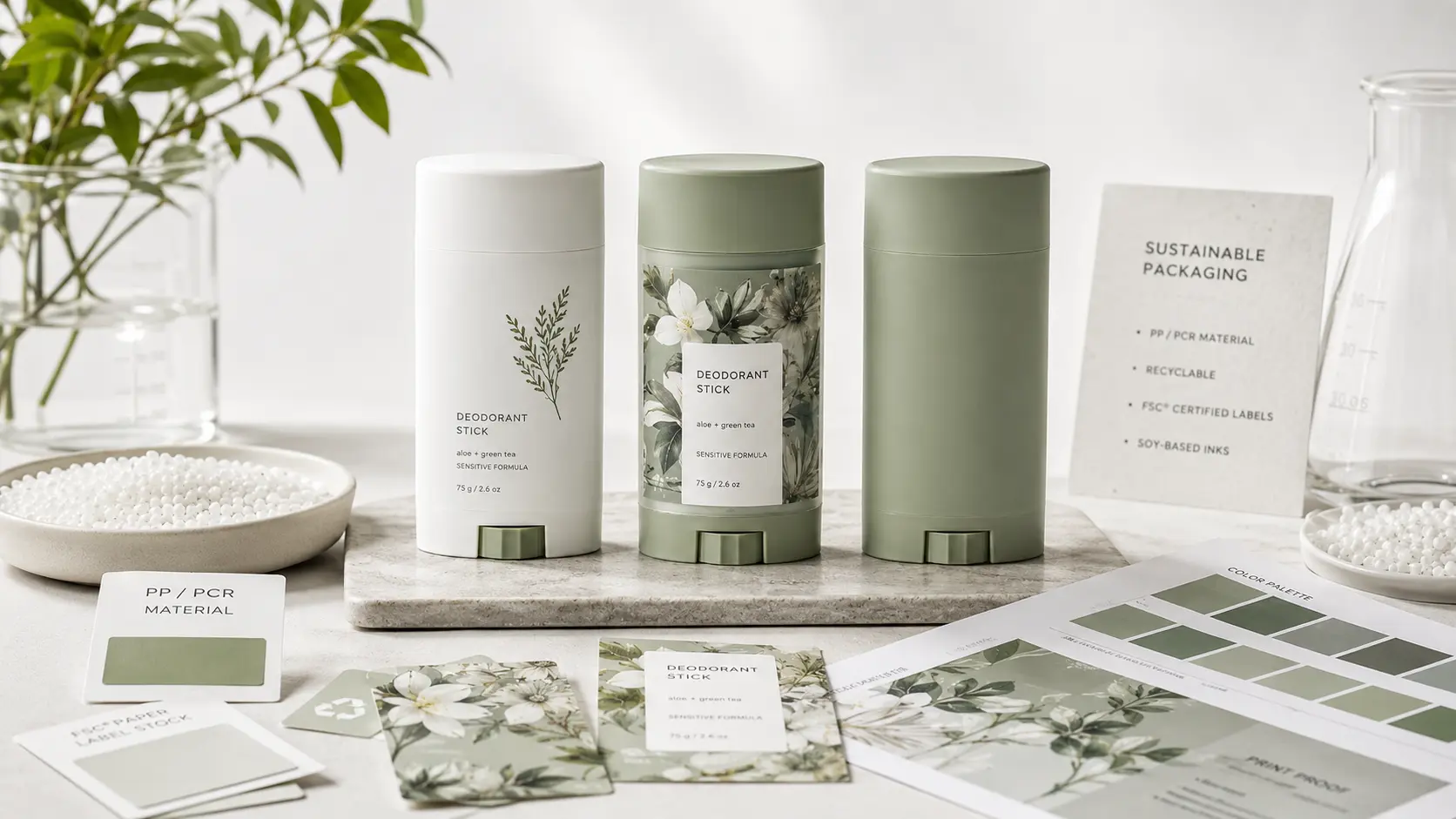
For emerging beauty brands and established personal care giants alike, the visual and tactile appeal of a product container is just as critical as the formulation inside. As the market shifts heavily toward eco-friendly designs, the core challenge for product developers in 2026 is no longer just finding a green container—it is how to execute premium branding on sustainable surfaces.
When custom-decorating your deodorant stick container, the two most reliable and widely utilized industry methods are Direct Silk Screen Printing and High-Definition Labeling. However, when working with eco-compliant substrates like Polypropylene (PP) or Post-Consumer Recycled (PCR) resins, each method behaves differently.
Here is a comprehensive procurement guide evaluating decoration technologies to help your brand achieve an ultra-premium, sustainable aesthetic while balancing cost and minimum order quantities (MOQs).
1. Silk Screen Printing: The Seamless, Monomaterial Masterpiece
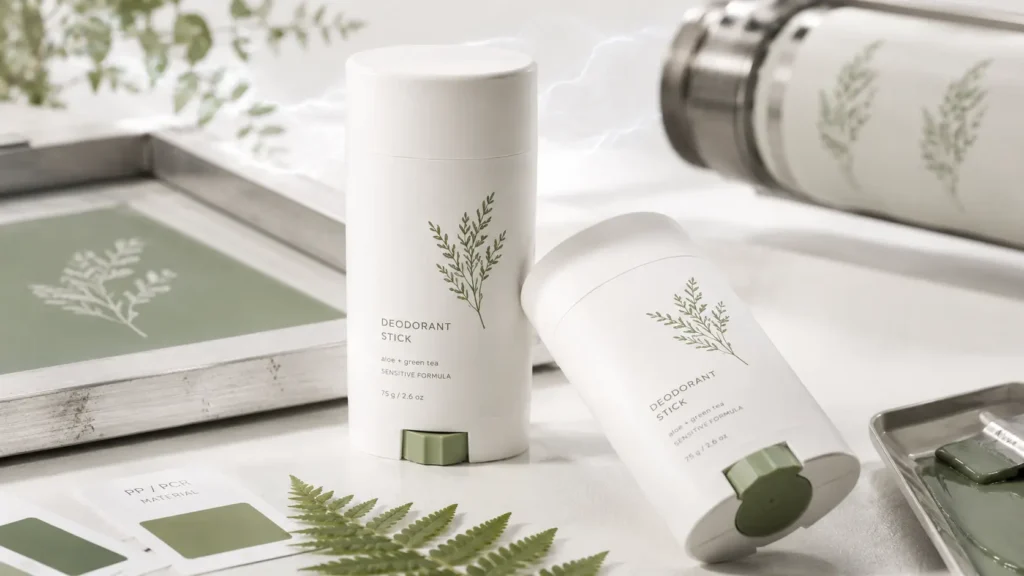
Direct silk screen printing involves pressing UV-curable inks directly onto the cylindrical surface of the plastic tube.
[UV Inks] ──> [Mesh Screen with Artwork] ──> [Rotary Printing Cylinder] ──> Direct Application to Tube
The Visual & Tactile Experience
Silk screening is the gold standard for brands chasing a minimalist, high-end, or “Old Money” aesthetic. Because the ink is applied directly to the surface, there are no visible label edges. It offers a slightly raised, tactile texture under the fingers, conveying a sense of bespoke luxury and industrial precision.
The PCR Surface Challenge & Corona Treatment
If your technical team has already verified structural safety via deodorant packaging compatibility testing, you must now account for surface tension. Sustainable plastics—especially PCR-PP—often have micro-imperfections, minor color variations, or trace surface oils from the recycling lifecycle.
To ensure that screen-printed inks adhere perfectly without chipping, flaking, or scratching during transit, Nova Packaging implements an inline Corona Treatment. This electrostatic process temporarily alters the molecular structure of the PP surface, raising its surface energy so the ink bonds permanently to the recycled polymer.
Pros & Cons for Sourcing
- Pros: 100% monolithic look; zero risk of label peeling or bubbling; enhances the container’s circular economy profile since no foreign materials (adhesives/facestocks) are added to the PP recycling stream.
- Cons: Higher initial setup costs for screen matrices; color limitations (typically restricted to 1–3 spot colors); less cost-effective for multi-colored, highly complex gradients.
2. HD Labeling: Ultimate Flexibility for Complex Artwork
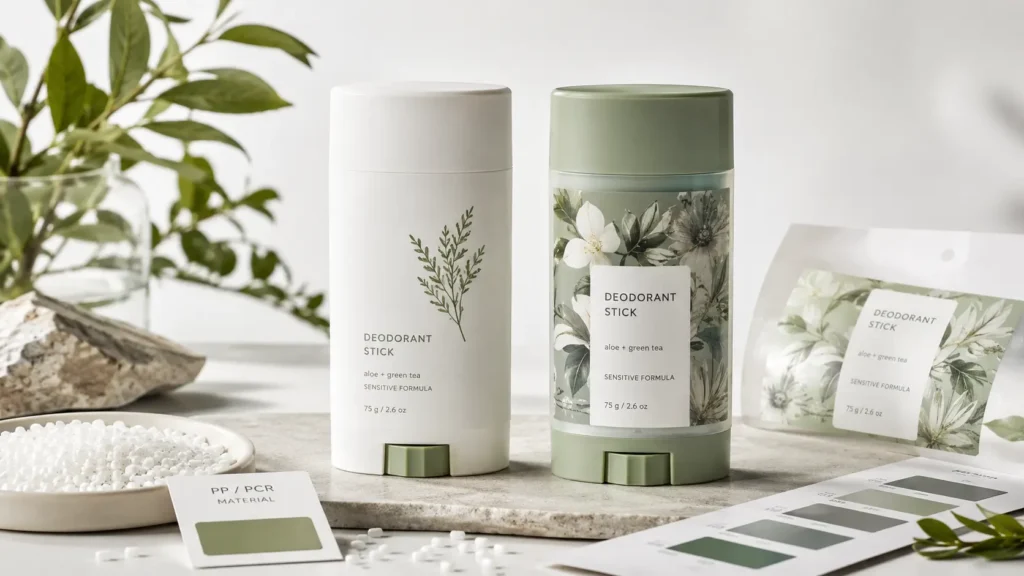
High-definition labeling involves printing artwork onto a separate substrate (such as PP film, paper, or clear PE) and applying it to the deodorant tube using high-performance pressure-sensitive adhesives.
The Visual & Tactile Experience
Labeling is the ultimate vehicle for brands requiring photorealistic imagery, intricate botanical illustrations, or multi-colored metallic foils. Modern clear-on-clear “no-label-look” films can mimic direct printing, while premium textured paper stocks (such as textured hemp or FSC-certified sugarcane paper) emphasize an organic, clean-beauty identity.
Sourcing & Recycling Compatibility
The biggest pitfall in sustainable labeling is creating a “hybrid packaging nightmare” that ruins the container’s recyclability. If you apply a standard permanent acrylic adhesive and a non-recyclable vinyl label onto an otherwise perfect all-PP mono-material stick, municipal recycling scanners will reject the entire unit.
To maintain your eco-compliance, 2026 sourcing mandates dictate using Monomaterial Matching:
- If your stick is made of PP, your label facestock must be made of PP.
- Utilize wash-off or clean-peel adhesives that completely separate from the tube during the recycling wash phase, leaving the pure PP resin uncontaminated.
Pros & Cons for Sourcing
- Pros: Infinite color variance and gradient capability; lower MOQs for initial product launches; easily adaptable for multi-SKU product lines (e.g., changing scent variants without altering the base container inventory).
- Cons: Visible label seams (unless a full-wrap design is engineered); potential for edge-lifting, bubbling, or wrinkling if exposed to humid bathroom environments; added layer of material overhead.
3. Procurement Comparison: Choosing Your Decoration Path
To streamline your supply chain decisions, evaluate how these two methods stack up across critical production metrics:
| Metric | Direct Silk Screen Printing | High-Definition Labeling |
| Aesthetic Vibe | Minimalist, Tactile Luxury, Clean | Vibrant, Detailed, Multi-SKU Flexibility |
| Color Capacity | Best for 1–3 Solid Pantone Colors | Full CMYK, Gradients, Foil Stamping |
| Surface Finish | Matte, Gloss, or Textured Ink | Matte, Gloss, Metallic, Textured Paper |
| MOQ Impact | Higher (Typically 10,000+ units due to line setup) | Lower (Can adapt to digital printing for 3,000+ units) |
| Recyclability Rating | Excellent (Does not contaminate resin stream) | Conditional (Requires wash-off adhesive & PP facestock) |
4. The 2026 Customization Roadmap
When designing a premium sustainable deodorant line, follow this strategic workflow to avoid manufacturing bottlenecks:
- Define Your Brand Identity Early: If your brand leans into a quiet luxury aesthetic with neutral palettes, prioritize matte-finish PP tubes with single-color black or charcoal silk screening. If your brand relies on bold, vibrant colorways, invest in PP-matched film labels with clean-peel adhesives.
- Request Decoration Proofs on PCR Stock: Never approve an artwork proof on virgin plastic if your production run will use PCR. Recycled resins have a natural grey or off-white undertone that can slightly shift your Pantone color accuracy. Always review physical color drawdowns directly on the recycled material.
- Coordinate with the Filling Line: Ensure your decoration choice is compatible with your contract filler’s assembly line. For instance, silk-screened tubes can withstand higher temperatures during top-fill hot-pour processes without wrinkling, whereas certain low-spec labels may bubble under intense radiant heat.
- Procurement Note: Verifying custom decoration adherence doesn’t stop at artwork approval. Learn how our factory runs strict cross-hatch tape and drop tests on mass-produced batches in our next guide: How to Inspect Deodorant Stick Containers: 5 Quality Control Steps Before Mass Production.
Engineering Premium Aesthetics with Nova Packaging
At Nova Packaging, we bridge the gap between rigorous engineering and luxury brand design. We offer full-scale OEM/ODM customization capabilities, including advanced multi-color silk screening, precision corona treatment for PCR, and eco-certified monomaterial labeling options. Our technical sales team is ready to assist you in aligning your artwork requirements with the ultimate sustainable container architecture.
Want to see the difference in person? Contact the engineering and design division at Nova Packaging today to request a custom curation sample kit showcasing silk-screened vs. labeled sustainable deodorant stick tubes.