For cosmetic brand owners and global procurement managers, the transition from approving a beautiful design sample to receiving tens of thousands of mass-produced units is always filled with supply chain anxiety. For functional packaging like a deodorant stick container, a single mechanical flaw across a production batch can lead to extensive brand damage, messy leaks, and customer returns.
To safeguard your brand reputation and ensure flawless product performance, you must hold your packaging manufacturer to strict Quality Control (QC) standards.
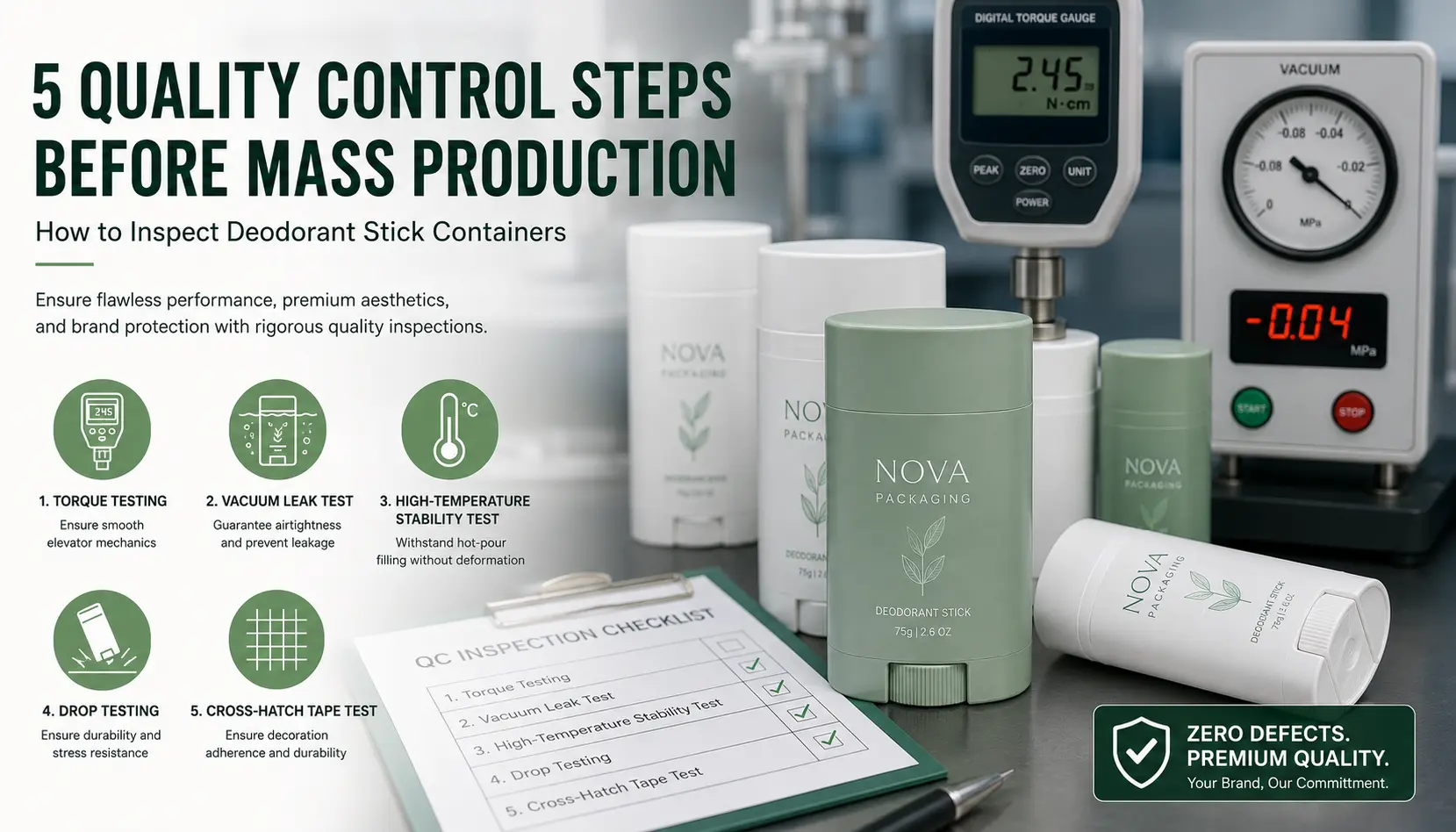
Here are the 5 critical quality control steps that Nova Packaging performs before and during mass production to guarantee retail-ready execution in 2026.
1. Torque Testing: Ensuring Smooth Elevator Mechanics
The core functionality of a deodorant stick container relies on its internal twist-up mechanism—the spindle, the screw, and the elevator platform. If the mechanism is too tight, the consumer cannot twist the product up; if it is too loose, the deodorant mass will collapse under pressure during use.
[Digital Torque Gauge] ──> Measures Rotary Resistance (N·cm) ──> Establishes Perfect User Experience
- The QC Test: Technicians utilize digital torque gauges to measure the precise twisting force required to actuate the mechanism.
- The Technical Standard: A standardized torque range—typically between 1.5 to 5.0 N·cm (Newton centimeters)—is established. Any batch with torque deviations is immediately flagged for mold clearance or assembly line adjustments.
2. Vacuum Leak Testing (Airtightness Stick Only)
Whether your formulation is volatile silicone-and-oil-based or propylene glycol-and-water-based, container airtightness prevents evaporation, product shrinkage, and leakage during hot-pour filling lines.
- The QC Test: The fully assembled deodorant stick is placed inside a sealed vacuum chamber submerged in water. The chamber air pressure is reduced to create a negative pressure environment (usually -0.03 to -0.05 MPa).
- The Failure Indicators: Technicians monitor the container for a continuous stream of air bubbles escaping from the bottom seam or the cap seal. Zero bubbling over a 60-second test ensures a secure seal that prevents volatile ingredients from escaping.
3. High-Temperature Hot-Pour Thermal Stability Test
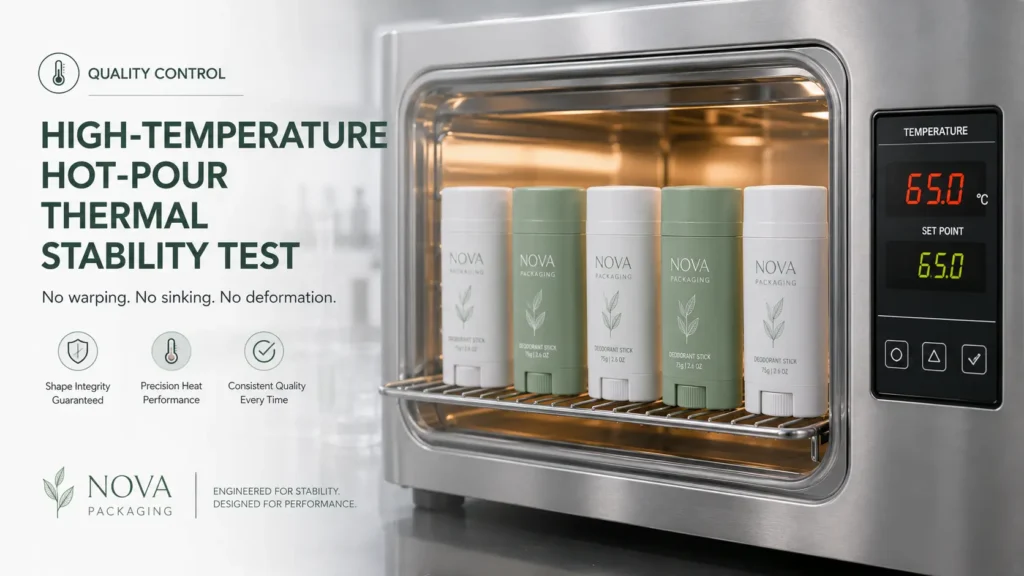
Deodorants and antiperspirants are filled into containers as liquids at elevated temperatures, generally between 55°C and 70°C, before cooling into solid sticks. The packaging must withstand this thermal shock without a millimeter of deformation.
- The QC Test: Empty containers are passed through a mock heating tunnel or subjected to simulated hot-fill temperatures in a laboratory environment.
- What We Look For: Technicians inspect the containers for plastic warping, wall sinking, or ovalization of the cylindrical tube. Ensuring high thermal stability is particularly crucial when dealing with PCR-PP (Post-Consumer Recycled Polypropylene) resins, which require narrower processing windows than virgin plastics.
4. Cartesian Drop Testing & Stress Resistance
From warehouse shipping pallets to consumer bathroom floors, deodorant sticks endure significant physical impacts throughout their lifecycle.
- The QC Test: Filled, finished deodorant units are placed in a controlled drop tester. The packages are dropped from a standard height of 1.2 meters onto a hard concrete surface at multiple angles: flat on the base, flat on the cap, and directly on the critical 45-degree edge seam.
- The Technical Standard: The structural integrity must remain uncompromised. There should be no plastic shattering, cap separation, or internal mechanism dislocation. This ensures your products survive global logistics and rough handling intact.
5. Cross-Hatch Tape Test for Custom Decoration Adherence
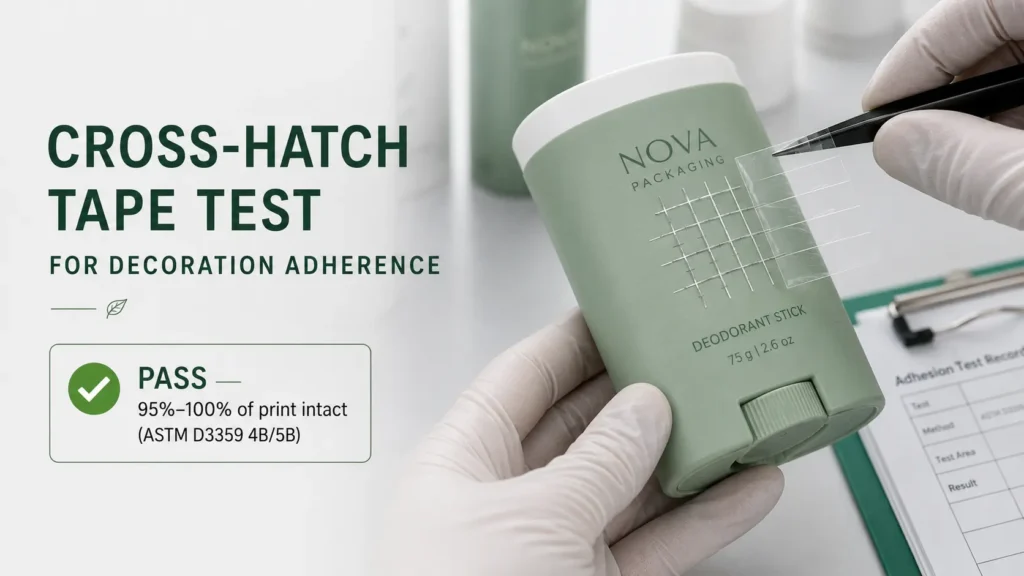
If your brand invested in premium aesthetics—such as the custom methods analyzed in our guide on silk screening vs. labeling for deodorant sticks—ensuring that the branding doesn’t peel or scratch off during transit is a priority.
- The QC Test: Technicians perform a Cross-Hatch Adhesion Test on decorated production samples. Using a precise cutting tool, a grid of 100 tiny squares is carved directly into the printed ink or applied label area. Standard 3M pressure-sensitive tape is applied firmly over the grid and pulled away sharply at a 180-degree angle.
- The Technical Standard: To pass mass production compliance, 95% to 100% of the printed area must remain perfectly intact (Classification 4B/5B under ASTM D3359 standards). This guarantees your branding looks pristine from the factory floor to the retail shelf.
Secure Your Supply Chain with Nova Packaging
High-quality cosmetic packaging isn’t an accident; it is the result of rigorous engineering and unyielding quality control. At Nova Packaging, every batch of our sustainable, mono-material, and PCR deodorant stick containers undergoes these 5 essential inspection steps to ensure a 0% critical defect rate.
Need an audited manufacturing partner for your next launch? Contact the engineering department at Nova Packaging today to receive a copy of our complete Quality Assurance Protocol (QAP) and request free, QC-tested production samples.